A new venture in the new year of 2011. My mind is set opened for Learning and Knowledge Analytics. What about you?
Tuesday, January 25, 2011
Posted on other blog on this
Saturday, January 22, 2011
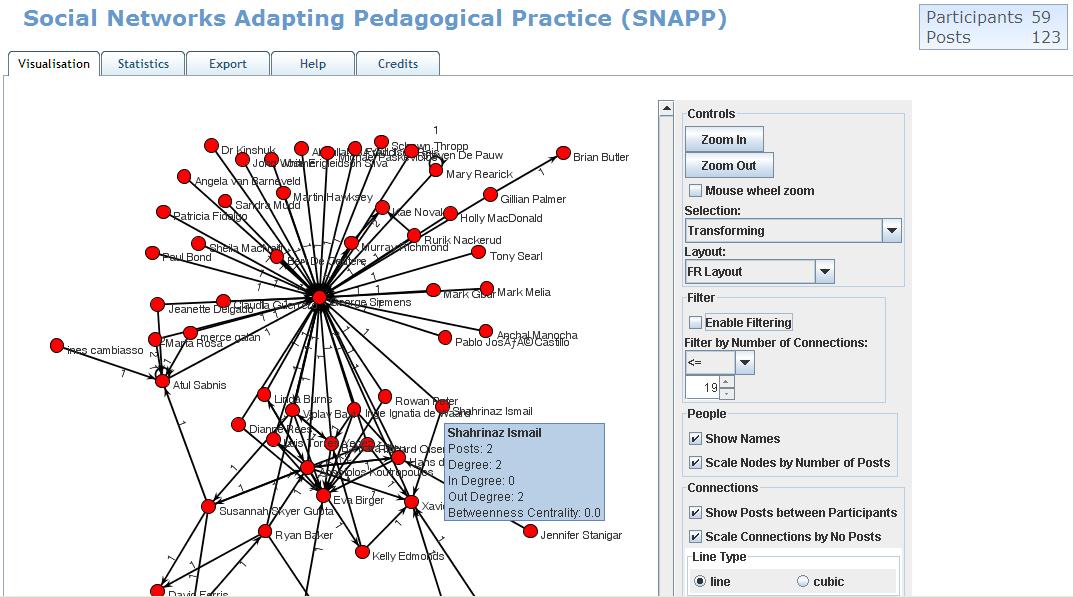
Similar to SNAPP, probably better!
Re: SNAPP look-alikes by George Siemens - Tuesday, 18 January 2011, 02:37 PM | ||
Hi Bert - in your request for SNAPP-look alikes, I assume you are referring to tools that map social networks. If so, there are numerous options available (some free, some not): Netdraw: http://www.analytictech.com/netdraw/netdraw.htm Pajek: http://vlado.fmf.uni-lj.si/pub/networks/pajek/ NodeXL: http://nodexl.codeplex.com/ Netminer: http://www.netminer.com/NetMiner/home_01.jsp Touchgraph: http://www.touchgraph.com/navigator Gephi: http://gephi.org/ UCINet: http://www.analytictech.com/ucinet/ etc. The reason we went with SNAPP for the week 2 activity is that it's a simple browser plugin and doesn't require manually loading data. It demonstrates social network analysis without needing the techical skills of the tools listed above. | ||
Friday, January 21, 2011
Discussion on SNAPP
- Keywords of discussion that the people pick up from each thread that makes the connection - it can show how a topic can disperse or branch out into new topics, and how/what the people actually understand from the original aim of the syllabus.
- Time gap between one person to another - it can show how long a person takes to catch up and what he/she may have missed that cause them to rely on those at the end of the thread.
- In real physical class scenario, students/learners may tend to catch up at the end of the 'semester', so they may not follow much in weekly basis; a function that could tell who may be a bit left behind - different colour or something?
- If it is logic that having more connections means you're a good learner, then maybe a function that shows the ranking in terms of number of connections (with other attributes/parameters) could assist in analysing the prospect "good" students.
- Understanding the patterns of connections and what learners have learnt may help in structuring the assessment better.
Falling for SNAPP
LAK11 Orientation Presentation
This may be useful if we want to practice similar method for our classes. I'm considering this myself already, at this moment.
- Shazz @ LAK
A short break...
Another comment posted on somebody's blog
January 21st, 2011 at 05:57
I totally agree with you, especially the last part. I myself thought that I can use my old method of strategising my way in accessing the information from the MOOC, so I (by habit) created a blog for this, even followed George in creating the NetVibes, and etc.
But I still find that it’s too wide and diverse, that I still have to depend on my skimming skill (if I have the time), my time (to go through the email notifications) and the facilitator’s review (and from there I would rather read the reviews posted by other learners instead of recommended readings by the facilitator!).
As you said, I least worry about all these, because as long as we know where they are and how to ‘search’ for it later on after the course, I think we’re quite save to catch up at later stage. The important thing is to contribute via reviews, because that would ensure our understanding, at least for our own relief.
- Shazz, Kuala Lumpur
Finding own paths in MOOC,
- Shazz @ LAK
21 Jan 2011
Thursday, January 20, 2011
A video worth a view...
Thanks for sharing this, LAK!
20 Jan 2011
Comment on Sheila's Blog
I agree with Mark. It's quite tough in the beginning, because of the 'panic' of not really knowing what we need to know in order to follow the topics... But thanks to previous experience in following George's teaching in 2008, I'm more confident in 'leaving behind' some of the texts/articles recommended to read in the study weeks.
In fact, I find it more comfortable reading others' reviews on the texts, and then go into the texts to 'understand the gist' myself and compare it with the reviews. At least some of the main ideas are already covered by the reviews, so we don't really miss much if we skim through and spot other points that interests us.
One thing for sure, what our eyes spot as interest might be a different angle of understanding compared to others. Interesting! ;D (even though it sounds like we tend to get lost too. LOL)
- Shazz, Kuala Lumpur
Sincerely, a learner,
- Shazz @ LAK
A quick response to one of the topics in Week 2
AK vs EDM vs Educational Research by Xavier Ochoa - Wednesday, 19 January 2011, 04:10 AM | ||
Today at the very interesting talk of Ryan Baker a question arise about the differences (and similarities) between Educational Data Mining, Learning and Knowledge Analytics and the traditional field of Educational Research. I think that this question deserves further exploration in this course. The definitions that those terms have in Wikipedia are very similar: Educational Research: Educational research refers to a variety of methods in which individuals evaluate different aspects of education including but not limited to: “student learning, teaching methods, teacher training, and classroom dynamics”. Educational Data Mining: Educational Data Mining (called EDM) is an emerging discipline, concerned with developing methods for exploring the unique types of data that come from educational settings, and using those methods to better understand students, and the settings which they learn in. Learning (and Knowledge) Analytics: Learning analytics is the use of intelligent data, learner-produced data, and analysis models to discover information and social connections for predicting and advising people's learning. Is there a difference? Do you think that EDM and LAK are just an evolution of Educational Research, but with better tools and data, or there is something radically different and unique in the new approaches? Do you think that EDM and LAK are synonymous or there is a meaningful difference between the two fields? Should we merge or we should keep them separated? Let's discuss. | ||
My review was as follows:
So far, this is what I understand from the 'research areas' that makes LAK (as shown in attached diagram).
- Shazz
Kuala Lumpur 10:30PM
Just started to 'follow' Week 2 activities,
- Shazz @ LAK
Dave's Review on Week 2 activities
Wednesday, January 19, 2011
My review entailing Viplav Baxi's comments
Re: What about learning analytics in the corporate sector? by Viplav Baxi - Sunday, 16 January 2011, 05:49 PM | ||
One of the areas that greatly interest me is simulations for corporate training needs. I have done work in the IT and Financial sectors that show the power of simulations to bring together some complex information about how a learner navigated a simulated job situation. Scores are too simplistic to do justice to such complex tracking of learner progress and competence. Consequently, learning & knowledge analytics become more complex as well. For example, let us consider a scenario that has multiple decision points (connected like in a graph) and multiple paths to the correct outcome. Let us assume that there is an ideal path (not hard to imagine in a highly disciplined process training). A learner's decision making trail or actions trail could be compared to the ideal path/trail and analytics could be programmed to infer from deviations to get a better and more comprehensive picture of learner performance. (also not unlike the notion of knowledge analytics being used to compare competency levels in a discipline). If you know cricket, you would be familiar with a graph that shows runs scored vs overs for both teams with circles denoting fall of wickets, resulting in what are popularly called "worms" that deviate from each other on the graph as the match progresses. Point is, these analytics move from being comparisions between numbers (Peter spent 5 more minutes than Pan on the google group), to being comparisons and analytics based on patterns and paths. Viplav | ||
Tailing this, I wonder:
- How can this pattern be presented to senior management (assuming they are not at 'our level of understanding') in a form that they appreciate?
- How can we be certain that the paths the employee takes in getting to the final point are something they learnt and contributing to the final result, or merely a waste of time until they found the right 'nodes'?
- How should the evaluation be designed to make it fair for every employee (because some people do take time to understand after a long-winded paths, etc...)?
- Does this mean an experienced 'wanderer' could achieve the KPI better than newbies? I don't think so too.
There's still further way to go after this, and I believe corporate sector is very particular about 'measurement' in evaluation.
Hope I'm in track with my points,
- Shazz
Kuala Lumpur 1:33AM
Extracting the gist - Learning Analytics in Corporate Sector
Monday, January 17, 2011
Week 2 Readings
Here to bookmark the syllabus for this week, for my later visit and ponder:
http://learninganalytics.net/syllabus.html#Week_2_
Wonder if I have time to read..., at least half of these?
- Shazz @ LAK
17 Jan 2011
Review on Critics of Learning Analytics
Critiques of learning analytics? by George Siemens - Sunday, 16 January 2011, 05:50 PM | ||
What are your concerns with analytics when applied to learning and knowledge? What types of critiques and concepts should we explore/consider? I've started with a few quick thoughts on the topic here: http://www.learninganalytics.net/?p=101 | ||
My honest response is as follows:
I guess I'm talking on behalf of 'small lecturers' in an establishing university that is yet to understand and realise the power of learning analytics.
My concerns are more on measurement, whether the results meet the initial objectives we want (because we tend to 'drown' in the pool of data overflow), and what's next...
I mean, we can analyse all we want from the stats and figures we retrieve, but do we really know what to do with it, or what difference can we make out of it? Because again, this is education management level, and the results may say that "this is for registrar dept to change, not me" or "this is my faculty board's responsibility, not me".
Honest opinion,
Shazz
Kuala Lumpur 6:13AM 17Jan2011
Hope to be in the right track on this,
Saturday, January 15, 2011
Review on presentation by G.Siemens
Check out the terms like "social data", "central nervous system", "intelligent curriculum", "locational data", and how all these can be put together to produce for us the 'learning analytics'...
Review on Elias (2011)
- Capture - capture of meaningless data
- Report - the data being reported as information
- Predict - enabling of predictions based on knowledge and wise action
- Act - the action results from the predictions
- Refine - self-improvement project where monitoring the impact of the project is a continual effort; statistical models should be updated on a regular basis
"If we do not re-present actions to the crowd through an interface that affects similaractions, it is just data mining for some other purpose. This is not a knowledgediscovery cycle."
- Select
- Capture
- Aggregate & Report
- Predict
- Use
- Refine
- Share
Review on Goldstein (2005)
Reviews by Schawn on Week 1 Readings
Thank you, Schawn, for the good review on Week 1 readings.
I would like to point out the 4 points you have summarised in here, especially item number 2 - "During the design of the learning experience how can the data be captured in a non-intrusive way. If you cannot design and develop the capturing this data in a non-intrusive way, how can you design it in a way where the student will participate in providing enough quality data."
It is true that it is not easy to get students to participate in the first place, even though they spend most time on the same tools for personal use. They somehow do not 'trust' the sharing of info through the tools, even if it benefits themselves. With that as a problem, another consequence is in getting 'quality data'. So far, I only manage to get less than 10% of the student number to participate actively and this also subsides in time. It's quite tricky to get good stats out of this kind of action research, without students' cooperation. They believe in 'open' source only for their personal benefit (taking) and they don't really bother or believe in giving back to the community (giving). There's always a lack of give-and-take in this situation. So how to go about it?
Defining goal is important, but then again, the action itself requires a lot of "promotion" and "negotiation with rewards" in order to get others participate and provide quality data. Not easy. If there's any way to sort out these 2 points, before getting reliable and valid results for the other 2 points, it would be wonderful...
- Shazz
Kuala Lumpur
Friday, January 14, 2011
Learning Analytics with Stats
More slides to share, I hope...,
- Shazz @ LAK